
By Ziyara.io 8 min read
On this page
If you run an Umrah or Hajj agency, your "software stack" probably looks like this: one giant Excel file, a WhatsApp group per departure, passport photos scattered across three phones, and a notebook where payments get written down when someone remembers.
It works — until the group grows past 30 pilgrims, or a second departure overlaps with the first, or the airline asks for a corrected manifest the night before the flight.
This guide covers what travel agency software for Umrah and Hajj groups must actually do, why generic travel tools fall short, where different products stop, and how to evaluate a platform in a single afternoon.
Opening a new agency? How to start an Umrah travel agency covers the steps that come before choosing software.
Why generic travel agency software fails Umrah & Hajj operators
Most "travel agency software" is built for selling individual trips: a customer, a booking, a confirmation email. Pilgrimage group travel is a different business:
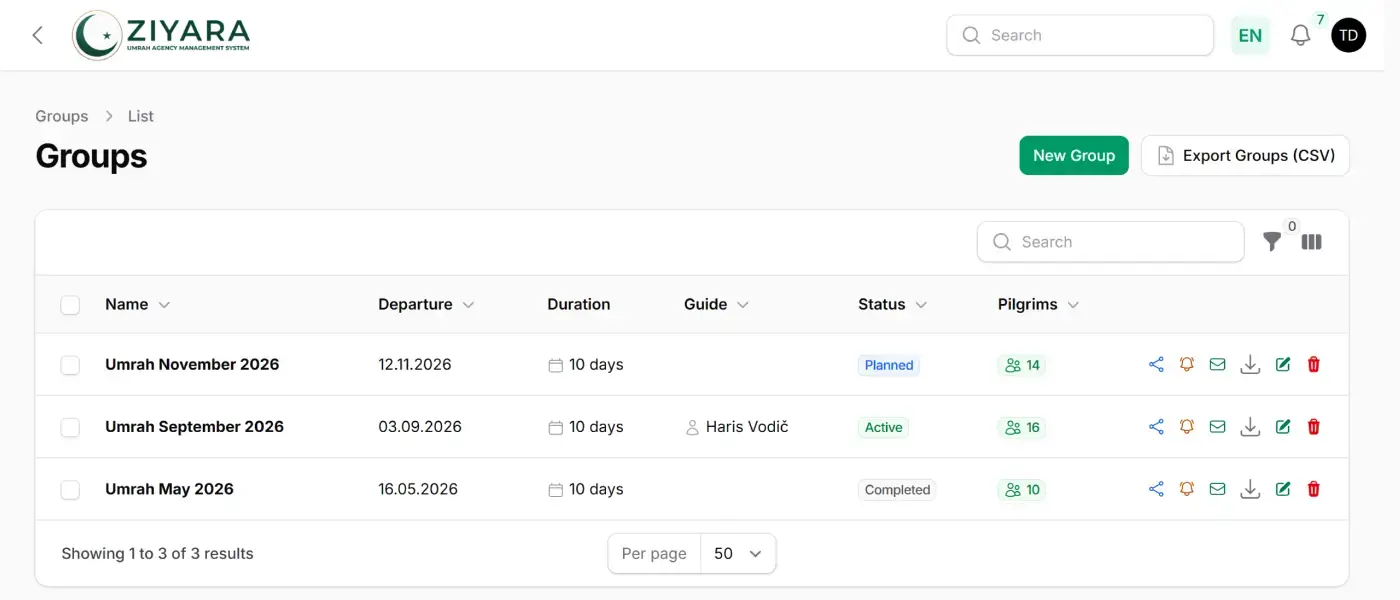
- You manage groups, not bookings. Forty to two hundred people traveling on the same dates, with shared hotels, shared buses and one manifest per flight.
- Rooming has rules. Rooms must stay single-gender, families want to stay together, and every room type (quad, triple, double) carries a different price.
- Documents are the product. Passports with six months' validity, visa files in the exact format the Saudi systems expect, airline-specific manifests.
- Pilgrims pay in installments. A deposit at signup, payments over months, and a final balance due before departure — often partly in cash.
A generic CRM has no concept of any of this. You end up rebuilding your Excel sheets inside a more expensive tool. Travel agency CRM vs Umrah group software compares the general categories task by task.
The 10 capabilities that actually matter
When you compare platforms, ignore the feature-count marketing and check these 10 things. Not every agency needs every item, but every vendor should tell you clearly what is built in, what needs another tool and what is not supported.
| Capability | What to look for |
|---|---|
| Pilgrim profiles | One record per pilgrim with passport data, documents, payment history and group membership — encrypted, not in a shared folder. Ask whether passport data can be read from the passport's code lines instead of typed |
| Groups, packages and leads | Departures with statuses and room-price tiers, plus an inquiry pipeline if you need to follow prospects before they become pilgrims |
| Self-registration | A mobile-friendly link in your pilgrims' languages, with document upload, duplicate checks and an approval step |
| Hotels, rooming and allotments | Makkah and Madinah rooming, live bed counts, family and gender rules, hotel-ready exports — and allotment/release-date tracking if you contract room stock |
| Flights and manifests | Outbound and return sectors, seat allocation, and passenger lists generated from approved data. Ask which carrier layouts exist and who updates them |
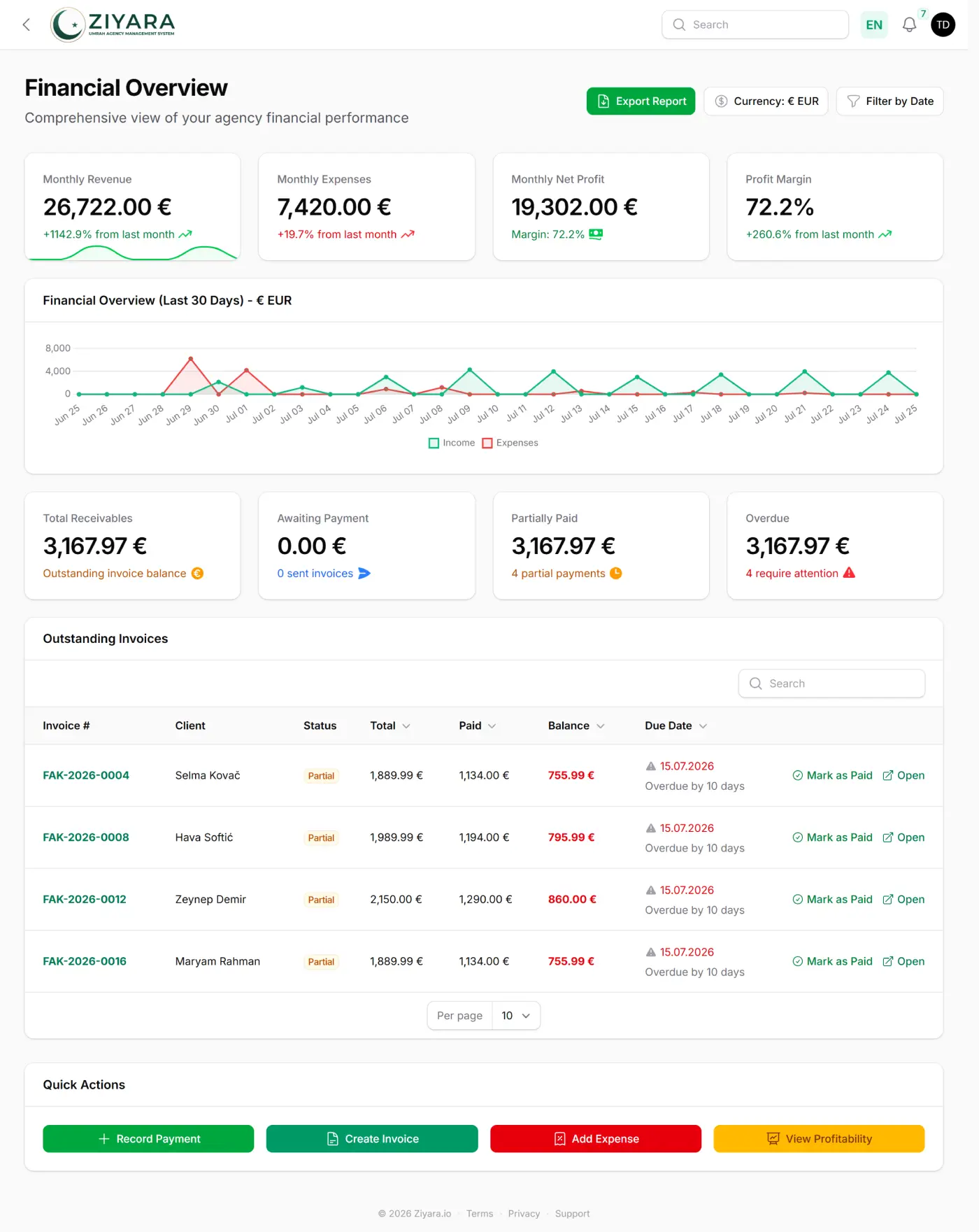
| Payments, expenses and profit | Per-pilgrim installments, receipts, overdue balances, group expenses and real profit — not just a revenue total |
| Communication and field use | Announcements, email or SMS where needed, a usable phone experience, and a clear way for guides and pilgrims to get the right live information |
| Security and accountability | Encryption for sensitive identity fields, tenant isolation, roles, activity logs, backups, hosting location and a Data Processing Agreement |
| Migration and data ownership | A tested Excel import, duplicate handling, export of your complete data, and a clear answer about help, cost and timing when you migrate |
| Boundaries and integrations | An honest list of direct connections to Nusuk, GDS, accounting, WhatsApp or payment providers — and an explicit "not supported" where no connection exists |
Score each item must have, useful or not needed before speaking to vendors. A smaller platform that covers every must-have is a better purchase than a long feature list that misses the workflow your team performs every day.
Four types of tools compared
| Excel + WhatsApp | Generic travel CRM | Custom-built portal | Purpose-built SaaS | |
|---|---|---|---|---|
| Cost to start | "Free" | €50–200/mo | €5,000–30,000 upfront | Subscription |
| Time to first group | Now (you're doing it) | Weeks of setup | 3–6 months | Days |
| Rooming & manifests | Manual, error-prone | Not included | If you specified it | Built in |
| Updates & new features | You | Vendor (generic ones) | Paid change requests | Included |
| Risk | Errors, burnout | Doesn't fit the work | Budget and time overruns | Vendor choice |
Excel isn't actually free — we break down its real cost in Stop Running Umrah Groups on Excel. And if a development shop has quoted you a custom portal, read Ready-Made SaaS vs Custom Portal Development before signing anything.
See one set of data move through the operation
The same approved pilgrim records feed rooming and flight preparation—without re-typing.
-

1. Import pilgrims
Bring in your existing list and approve complete pilgrim profiles.
-
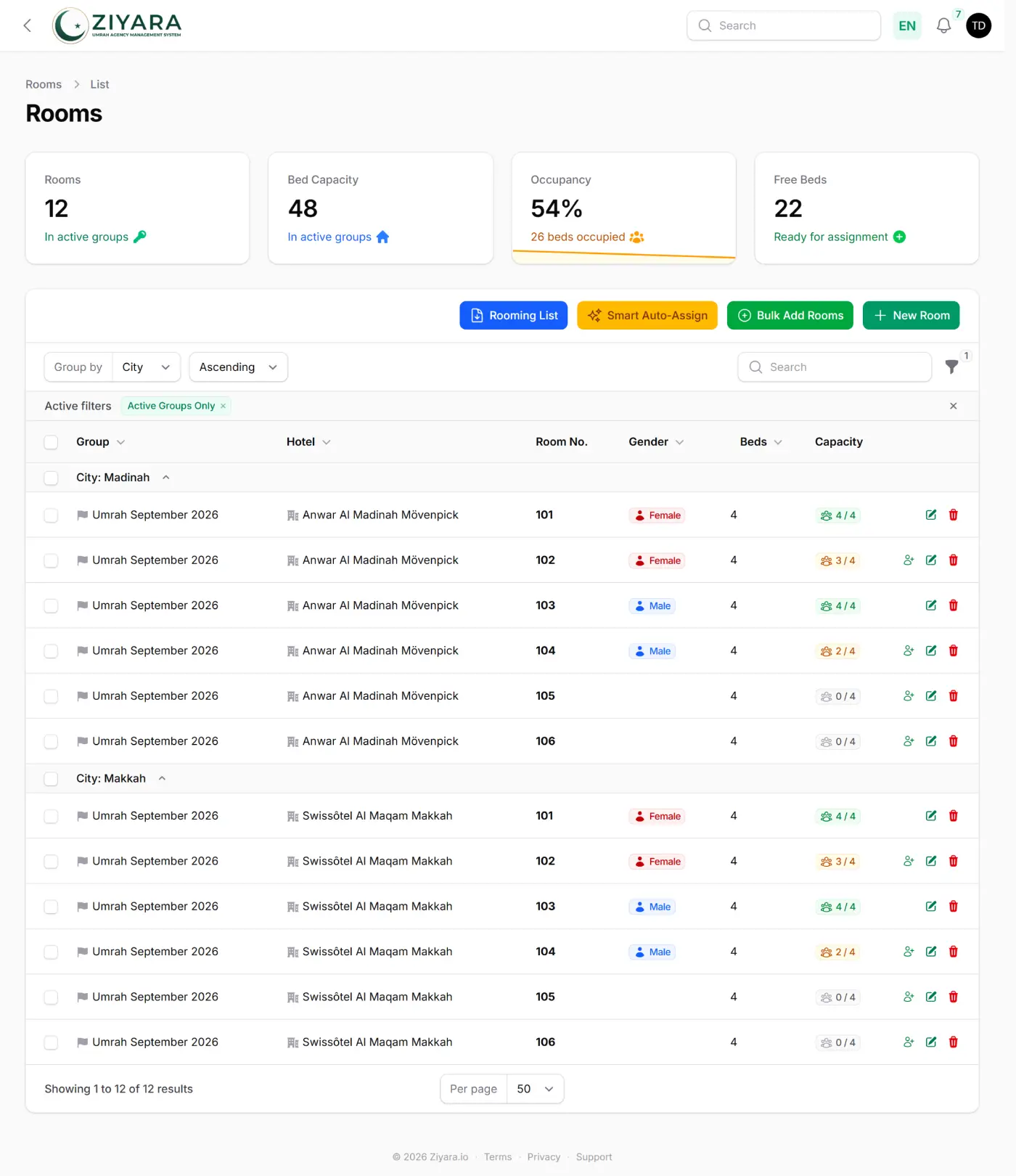
2. Assign rooms
Use those profiles for Makkah and Madinah rooming with live bed counts.
-

3. Prepare flights
Build flight lists and manifests from the same approved records.
Compare total cost, not one monthly number
Pricing models differ too much for a single market average to be useful. Compare the annual cost for your pilgrim volume, team size and required workflow. Put these lines next to every quote:
- Base subscription and the pilgrim, group or branch limit
- Extra users, per-booking charges and communication credits
- Import, onboarding and training fees
- Contract length, cancellation terms and the price after an introductory period
- Paid customizations or change requests
- The staff time still spent in spreadsheets because a required workflow is missing
Ask for the price in writing and use the same scenario for every vendor: your current annual pilgrim count, number of office users, number of branches and any migration help you require. Ziyara publishes its current Starter and Professional prices on the pricing page, so the amount you test is the amount you can buy without a sales call.
How to evaluate any platform in one afternoon
Do not decide from a polished demo. Get a trial account and run this checklist with your own data:
- Import 20 real pilgrims from your existing Excel. Did it detect duplicates? Where did the passport numbers go, and are they encrypted?
- Create one departure with two price packages (quad and double).
- Share the registration link with a colleague and have them register on a phone, in your market's language.
- Assign rooms in a Makkah and a Madinah hotel. Try to put a man in a women's room — the software should stop you.
- Generate a flight manifest and check it against what your airline actually accepts.
- Record two payments on one pilgrim and check the outstanding balance updates.
- Find the profit number for the group. If you cannot find it quickly, ask what costs or payments are missing from the calculation.
- Invite a second user with restricted permissions. Confirm what they can see, change and export, then find that action in the activity log.
- Export your data. Open the pilgrim list, rooming list and manifest outside the platform and confirm you can retrieve your information in a useful format.
- Ask the boundary questions: Does it connect directly to Nusuk or a GDS? Does it manage hotel allotments? Which communication channels are native? Get every "yes" demonstrated and every "no" recorded.
The result is not a universal winner. It is the platform that passes your must-have tests without creating a second spreadsheet beside it.
Where Ziyara fits — and where it does not
Ziyara is built for exactly this evaluation. It's a B2B platform for Umrah and Hajj agencies — pilgrim CRM with encrypted passport data, Excel import, self-service registration links in ten languages, Makkah/Madinah rooming with one-click auto-assignment, standard and carrier-oriented manifest preparation layouts, installment tracking, and live per-group profit. Confirm the current manifest template with the carrier before submission.
Every plan also includes a pilgrim mobile app — digital badges with QR check-in, push announcements, and a one-tap SOS button that sends the pilgrim's GPS location to your guide.
Best fit: an operating Umrah or Hajj agency that runs group departures and wants one source of truth from registration through documents, payments, rooming, manifests and post-trip profit. It is especially useful when the office and pilgrims work in different languages.
Not a fit by itself: an OTA needing live GDS inventory, a supplier marketplace, a white-label consumer booking engine, or an agency looking for direct Nusuk submission. Ziyara does not replace or connect directly to Nusuk or your Saudi operator; it prepares structured approved data and document exports for the workflow they specify. If direct inventory or a shared WhatsApp inbox is a must-have, keep a specialist tool beside Ziyara or choose a platform that demonstrates that connection.
Pricing is public on the pricing page, and the 30-day trial needs no credit card — enough to run the full checklist above with 20 of your own pilgrims before you decide.
A low-risk migration plan
- Choose a quiet window between departures; do not replace your process in the final week before a flight.
- Clean one active spreadsheet first: remove duplicates, standardize dates and decide which record is authoritative.
- Import one group, not your whole history. Complete the 10 tests, reconcile headcounts and balances, and let the staff member who actually builds rooming and manifests approve the result.
- Set a cutover date. After that date the new platform is the source of truth; the old sheet becomes read-only. Import older history only when the active workflow is stable.
Before committing, export the test group again. A migration is safe only when both entry and exit work.
Frequently asked questions
What is the best software for Umrah travel agencies?
The one that passes your must-have items from the 10-point checklist on one set of real group data. For most operating agencies that means pilgrim profiles, groups, registration, rooming, manifests, payments, profit, security, usable exports and a migration path. Test it with your own pilgrims before deciding.
Is there travel agency software made for Umrah and Hajj groups?
Yes. It is a small category of its own: group software organized around the departure, with single-gender rooming across Makkah and Madinah hotels, passport and visa data, flight manifests and installments per pilgrim. General travel agency management software and travel CRMs are built around one customer and one booking; our comparison of the two shows where each fits.
How much does Umrah agency software cost?
There is no useful universal price: vendors charge by agency, user, pilgrim, booking or branch, and custom portals add build and maintenance costs. Compare the annual total for your own volume, including onboarding, communications, extra users and any work that still remains manual.
Is there software for Hajj groups as well?
Yes. Rosters, rooming, documents, payments and manifests work the same way for Hajj; quotas, permits and the Mashaer logistics are handled through the official Hajj channels. Our Hajj group management guide explains how the two fit together.
Can I try Umrah software before buying?
Look for a free trial that is long enough to set up a real group — at least a few weeks — and doesn't ask for a credit card, so you can run the evaluation checklist above with your own data.
This guide was written with the help of AI tools. If you spot a mistake, please write to us at info@ziyara.io


