
By Ziyara.io 6 min read
On this page
The group came home on Sunday. Everyone was satisfied, the hotel was close to the Haram, the bus was on time. On Monday the owner looks at the bank account and cannot say whether the departure made seven thousand euros or two. The price sheet says seven. The account does not say anything, because three departures and the office rent are mixed in it.
Pricing tells you what a group should earn. Only a ledger kept per departure tells you what it did earn — and the two are never the same number.
The short answer: give every departure its own ledger. Record each cost against the group on the day you agree it, count income as money received rather than prices multiplied by pilgrims, and after the return compare the result with your price sheet line by line. The difference is where next season's price comes from.
Planned margin is a forecast, not a result
A price sheet assumes a full bus, the exchange rate of the day you quoted and no surprises. Our pricing guides use this example: 45 pilgrims, a true cost of €1,280 each, a price of €1,490 and a buffer of 4% of cost (how to price an Umrah package builds it step by step).
| The plan, 45 pilgrims | Amount |
|---|---|
| Income, 45 × €1,490 | €67,050 |
| Costs, 45 × €1,280 | €57,600 |
| Buffer, 4% of cost | €2,304 |
| Planned margin | €7,146 |
That is €158.80 a pilgrim. It is a good plan. It is also a number that exists only on paper until the group has travelled.
The same group, after it came home
Now suppose three seats stayed empty, the hotel was paid in riyals on a worse day than you quoted, and two pilgrims who arrived on a later flight needed their own transfer.
| What actually happened, 42 pilgrims | Amount |
|---|---|
| Income, 42 × €1,490 | €62,580 |
| Visas, insurance and flights, 42 × €870 | €36,540 |
| Hotels, contracted for 45 | €12,600 |
| Transport, ziyarat and guide | €5,850 |
| Exchange-rate difference on the hotel payment | €410 |
| Extra airport transfer | €160 |
| Actual profit | €7,020 |
The result is close to the plan — but only because the buffer was there. Here is where it went:
| Where the margin went | Amount |
|---|---|
| Three empty seats (€1,490 not earned, €870 not spent, each) | €1,860 |
| Exchange rate | €410 |
| Extra transfer | €160 |
| Total | €2,430 |
The buffer was €2,304. The surprises came to €2,430. Three empty seats alone used four-fifths of it, because the hotel rooms and the bus were already paid for: each empty seat cost €620, not the €158.80 of margin you might have guessed.
Without a ledger for this departure, the owner would only know that "it went fine". With one, there are two decisions for next season: close registration with a waiting list instead of hoping for the last three seats, and agree the hotel rate in the currency you sell in, or price the exchange risk.
How to keep a ledger per departure
- Record a cost when you agree it, not when you pay it. The hotel contract, the bus quote and the guide's fee are costs of this group from the day you say yes. Add the supplier and the due date, and mark it unpaid until the money leaves.
- Give every cost a category. Flights, hotels, visas, transport, meals, guide, marketing. After three groups the categories show you which line is drifting.
- Count income as money received. Forty-five registrations are not forty-five payments. Record each payment against the pilgrim, so the group's income is what has actually arrived (managing installments and payments).
- Put shared costs where they belong. A fee that covers two departures is split between them. Office rent and salaries are not group costs at all — keep them at agency level.
- Close the group after the return. Two weeks after landing, when the last supplier invoice is in, read three numbers: profit, profit per pilgrim, and profit as a share of income.
Costs that never reach the ledger
These are the lines agencies most often leave out, and each one makes a group look better than it was:
- The guide's own flight, room and visa, not just the fee.
- Free places — a group leader or a community figure who travels without paying.
- Bank and payment fees, and the cost of receiving money from abroad.
- Bags, ihram, badges and SIM cards handed out before departure.
- Refunds to pilgrims who cancelled, and what the suppliers kept anyway.
- The exchange rate between the day you quoted and the day you paid.
The Umrah package cost breakdown lists every line a package should carry; the free package cost sheet holds them in a spreadsheet.
Group profit is not agency profit
A departure that earns €7,020 has not made the agency €7,020. Rent, salaries, software, marketing and the accountant are paid out of the sum of all groups. Whether that sum is enough is a different question, answered in is an Umrah travel agency profitable?, which works through a first year with the same numbers.
Keep the two levels apart. Group profit tells you which departures, prices and hotels work. Agency profit tells you whether you have enough of them.
Where Ziyara fits — and where it does not
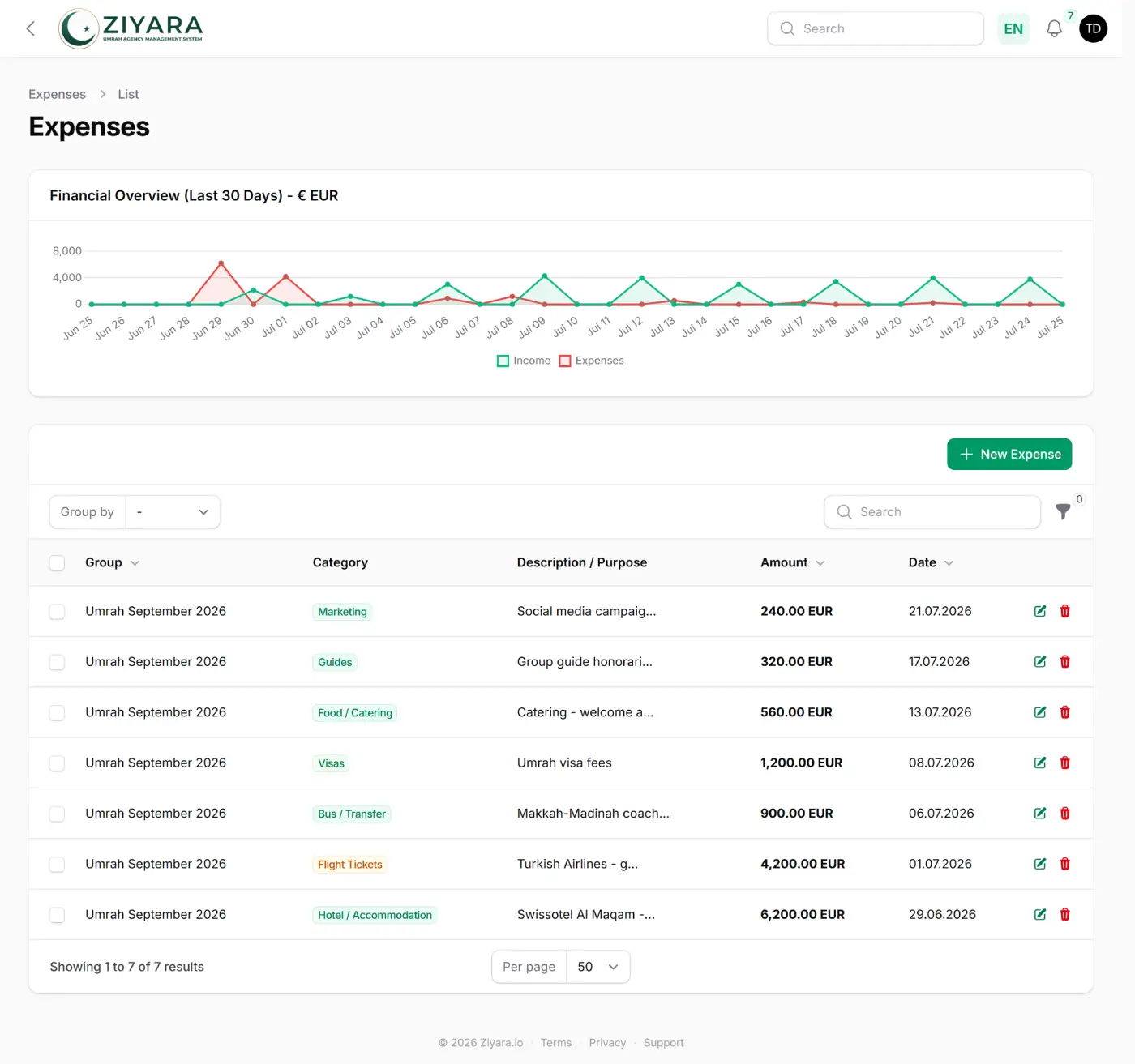
In Ziyara payments are recorded against each pilgrim on every plan, so a group's income is always what has been received. On the Professional plan each expense is recorded against a group with its category and supplier, an unpaid expense stays visible as a supplier bill until you pay it, and the profit view shows collected payments, recorded expenses and the difference for every departure. The financial report exports as a PDF for your accountant.
What it does not do: Ziyara is not accounting software. It keeps no general ledger, files no tax returns and is not connected to an accounting system — your accountant still does the books. And the profit it shows is only as complete as the costs you record: a group with no expenses entered looks more profitable than it was. The full checklist for choosing a system is in the buyer's guide to Umrah & Hajj agency software; prices are on the pricing page.
Frequently asked questions
How do you calculate the profit of an Umrah group?
Add up the money actually received from that group's pilgrims and subtract every cost recorded against the departure: flights, visas, hotels, transport, guide, meals and extras. Leave office costs out; they belong to the agency, not to the group.
How much does an empty seat cost?
More than the margin on one pilgrim. In our example a seat sold earns €1,490 and saves no hotel or bus cost when it stays empty, so each empty seat costs €620 — the price minus the €870 of visa, insurance and flight that were not bought.
What margin should an Umrah group make?
There is no standard figure. Our worked example plans about 11% of the price after a 4% buffer and ends, with three empty seats, at about 11% of a smaller income. Use your own supplier quotes and decide the margin you need from your running costs.
Should office rent and salaries be included in group profit?
No. Group profit shows what a departure contributed. Rent, salaries and marketing are covered by the contributions of all groups together, which is why a profitable group does not guarantee a profitable year.
When should a group be closed?
When the last supplier invoice has arrived and the last pilgrim payment or refund is settled — usually within a few weeks of the return. Closing it while the details are fresh is what makes the numbers useful for the next price sheet.
This guide was written with the help of AI tools. If you spot a mistake, please write to us at info@ziyara.io


